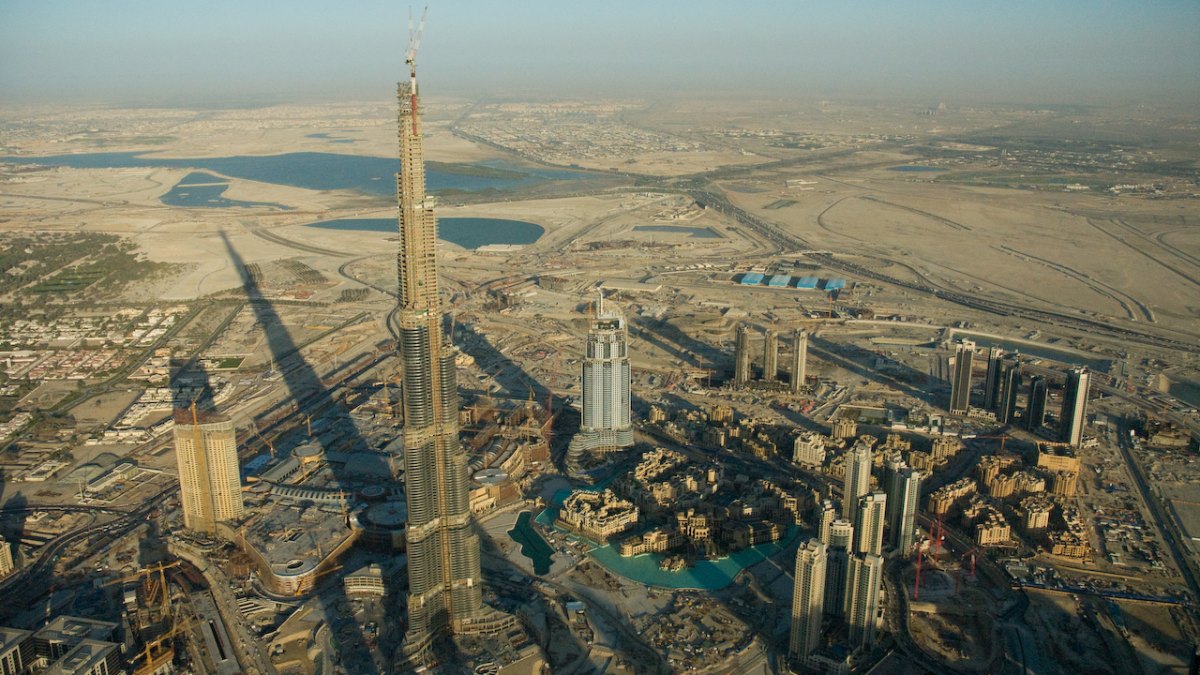
The Burj Khalifa rises 828 meters (2,717 feet) above downtown Dubai, a figure roughly twice the height of the Empire State Building's roof. Construction ran from 2004 to 2009, with the official opening on 4 January 2010. The project employed more than 12,000 workers at peak, poured 110,000 tons of concrete, and added a steel spire that pushes the structure past every rival on Earth by more than 200 meters.
Architecture and the Y-shaped core
Lead architect Adrian Smith of Skidmore, Owings & Merrill drew the floor plan as a three-lobed "Y," echoing the regional Hymenocallis flower and the spiral minaret. Structural engineer Bill Baker turned that geometry into a buttressed core, where each of the three wings braces the others against torsion. The result is a tower that uses about 6 percent less steel than a conventional tube design while reaching 163 floors above ground plus one underground level.
By the numbers
- Height: 828 m (2,717 ft) to tip; observation deck on floor 148 sits at 555 m.
- Floors: 163 above ground, 1 below; total floor area near 309,473 m2.
- Elevators: 57 cars, with the fastest moving at 10 meters per second (about 22 mph).
- Stairs: 2,909 steps from the ground lobby to the 160th floor.
- Cladding: 24,348 reflective glass panels covering roughly 132,000 m2.
- Concrete poured: 110,000 tons, with the tower weighing about 500,000 tons in concrete equivalent.
Engineering for heat and wind
Dubai routinely hits 50°C in summer, so the 24,348 cladding panels were specified with reflective coatings to bounce solar load before it reached the interior. Cooling demand still runs high; on a peak day the tower needs cooling roughly equal to melting 12,500 tons of ice. At the spire, the building can sway up to 1.5 meters laterally in a strong gust, a movement deliberately tuned by the Y-shaped plan so the wind cannot lock onto a single resonant frequency.
Money, politics, and a new name
The price tag landed near US$1.5 billion, modest for a structure of this scale. When Dubai's property market seized in 2008, neighboring emirate Abu Dhabi stepped in with rescue financing worth roughly US$10 billion across Dubai's wider debt. At the 2010 opening the tower was renamed from Burj Dubai to Burj Khalifa in honor of UAE President Sheikh Khalifa bin Zayed Al Nahyan, a public thank-you for that bailout.
Will it stay number one?
The next contender is Saudi Arabia's Jeddah Tower, designed by the same Adrian Smith to reach about 1,000 meters, roughly 172 meters taller than Burj Khalifa. Work began in 2013, stalled in 2018 at around the 63rd floor, and only restarted in 2025 after a 7-year pause. Until that tower tops out, the Dubai spire remains the highest occupied point on the planet.
For 16 years and counting, one building has held the global height crown longer than any skyscraper since the original World Trade Center, a streak few engineers in 2004 expected to last this long.
Beyond the records, the Burj Khalifa changed how cities sell themselves. Roughly 17 million visitors have ridden its elevators since 2010, the observation deck alone clears more than US$30 million in annual ticket revenue, and the building anchors a downtown district whose property values jumped over 40 percent in the decade after opening. A single 828-meter shaft of concrete and glass turned out to be one of the highest-leverage marketing assets any city has ever built.
💬 Discussion (0)
Leave a Comment