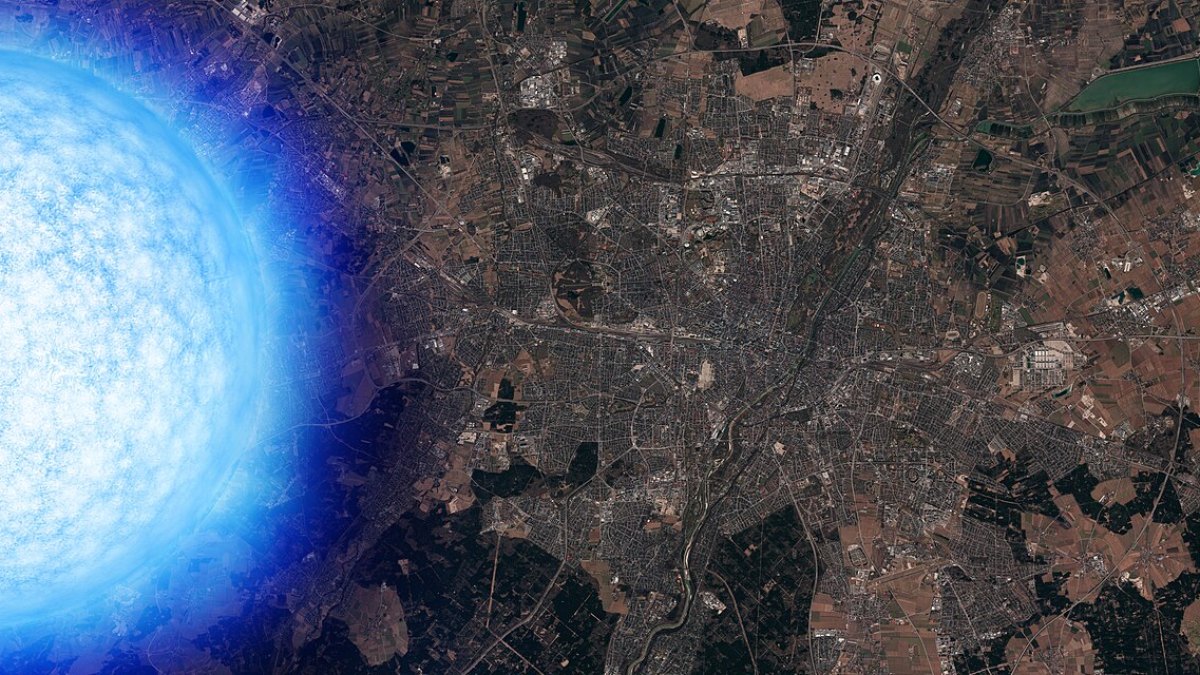
Imagine holding a teaspoon that weighs as much as 6 billion tons. That’s the astonishing reality when it comes to neutron star material. Neutron stars, the dense remnants of massive stars, are so tightly packed that a mere teaspoon of their matter is equivalent to the weight of all human-made structures combined. This unimaginable density results from a star's catastrophic collapse, compressing its mass into a sphere only about 20 kilometers in diameter. Such a small volume with such enormous mass makes neutron stars one of the most exotic objects in the universe, challenging our understanding of matter and physics.
The Formation of Neutron Stars
Neutron stars are born from the explosive death of massive stars, known as supernovae. When a star at least eight times the mass of our Sun exhausts its nuclear fuel, it can no longer support its own gravity. The core collapses, and the outer layers are expelled. The core's collapse continues until protons and electrons merge to form neutrons, creating a neutron star. This transformation leaves behind an object with a density so extreme that a cubic centimeter of neutron star matter can weigh as much as Mount Everest. These remnants are composed almost entirely of neutrons, hence their name, and are held together by gravity and neutron degeneracy pressure.
Unique Properties of Neutron Stars
Neutron stars possess several unique and fascinating properties. They have incredibly strong magnetic fields, often trillions of times more powerful than Earth's. These magnetic fields can accelerate particles to near-light speeds, emitting intense radiation observable from Earth. Additionally, neutron stars can rotate at astonishing speeds, with some spinning hundreds of times per second. This rapid rotation, combined with their magnetic field, can produce beams of radiation that sweep across the sky, observed as pulsars. Neutron stars also have surface gravity about 2 billion times stronger than Earth’s, making them one of the most extreme environments known.
Challenges in Studying Neutron Stars
Despite their remarkable properties, studying neutron stars presents significant challenges due to their small size and immense distance from Earth. Most neutron stars are located thousands of light-years away, making direct observation difficult. Scientists rely on indirect methods, such as observing pulsar emissions or gravitational waves, to gather data. Instruments like the Neutron star Interior Composition Explorer (NICER), launched by NASA in 2017, aim to measure their size, mass, and other characteristics with unprecedented precision. These studies help researchers understand the state of matter under extreme pressure and contribute to broader astrophysical knowledge.
In conclusion, neutron stars continue to captivate scientists and the public alike with their extraordinary properties. Their formation from supernovae, unique characteristics, and the challenges they present for study make them one of the most intriguing objects in the universe. As research tools become more advanced, our understanding of these cosmic wonders will only deepen, potentially unlocking new insights into the fundamental laws of physics and the nature of the universe itself.
- Neutron stars are about 20 kilometers in diameter but contain more mass than the Sun.
- The magnetic fields of neutron stars can be trillions of times stronger than Earth's.
- Some neutron stars, known as pulsars, can rotate hundreds of times per second.
- NASA's NICER mission studies neutron star interiors to learn more about their properties.
- Neutron stars' gravity is 2 billion times stronger than Earth's, impacting nearby matter significantly.
💬 Discussion (0)
Leave a Comment