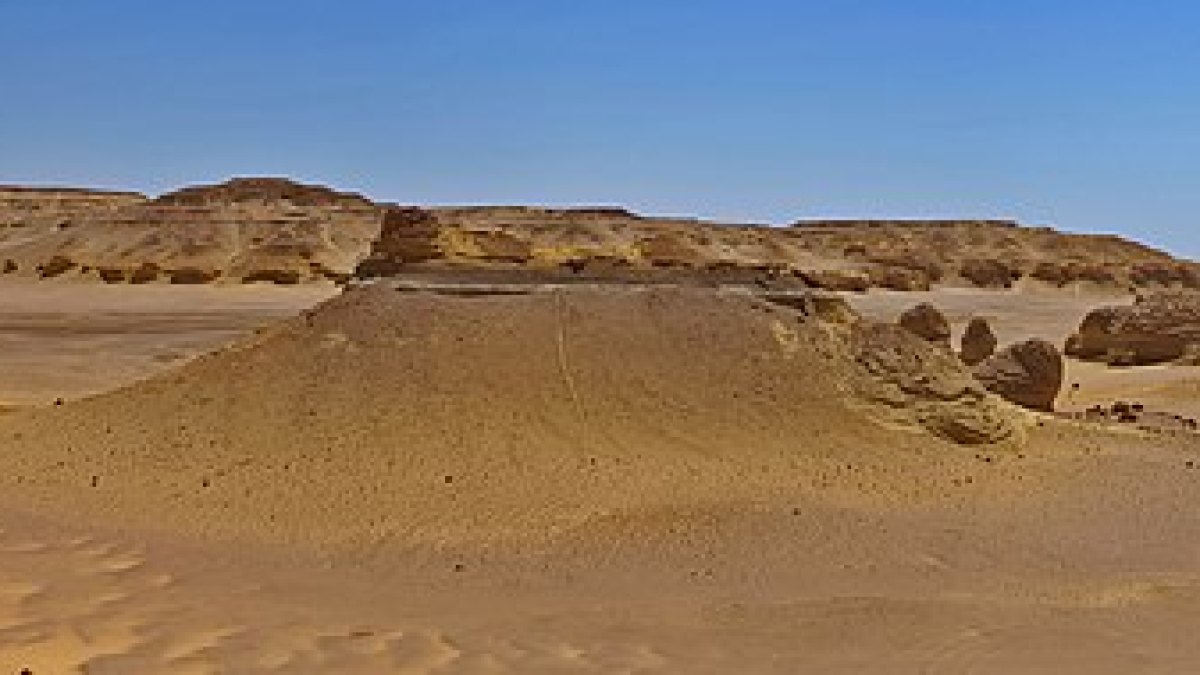
The Sahara is one of the driest places on Earth. Annual rainfall in Egypt's Western Desert averages less than 25 millimeters in most areas, barely enough to register. So it stops you cold when you learn that the fossils eroding out of these dunes are whales. Not small ones, either. Creatures up to 18 meters long, their skeletons scattered across a protected valley like ships wrecked on a forgotten shore.
Wadi El Hitan sits within the Wadi El Rayan Protected Area in the Faiyum Governorate of Egypt. UNESCO inscribed it as a World Heritage Site in 2005, citing it as the most important site in the world for illustrating one of the great stories in evolutionary history: the transition of whales from four-legged land mammals to the ocean giants we recognize today.
When the Sahara Was an Ocean
Between roughly 37 and 40 million years ago, during the Eocene epoch, a warm shallow body of water called the Tethys Sea covered what is now the Egyptian portion of the Sahara. The climate was dramatically different, humid, tropical at the margins, and teeming with marine life. Basilosaurus and Dorudon, two families of early archaeocete whales, were apex predators and common inhabitants of this sea. When the Tethys receded as tectonic plates shifted and sea levels dropped, their remains were buried in sediment. Millions of years of erosion have since stripped that sediment back, leaving bones at or near the surface.
The site covers approximately 200 square kilometers. Hundreds of individual whale skeletons have been identified within it.
What the Fossils Show
- Basilosaurus isis: The larger of the two primary species found at Wadi El Hitan, reaching up to 18 meters in length. Despite the name, assigned before its true nature was understood, it is not a reptile but an early whale. Critically, specimens preserve vestigial hind limbs: small but fully formed legs, including femur, tibia, and foot bones, that served no locomotive purpose in an animal already fully aquatic.
- Dorudon atrox: A smaller relative, roughly 5 meters long. Dorudon fossils at Wadi El Hitan include juveniles and adults, providing a rare look at growth stages in an ancient species. Like Basilosaurus, Dorudon retains reduced hind limbs.
- Associated fauna: The fossil beds also contain sharks, rays, sawfish, sea turtles, sirenians (early sea cows), and crocodilians, a detailed snapshot of an entire Eocene marine ecosystem.
- Preserved stomach contents: Some Basilosaurus specimens retain fish bones within their abdominal cavities, providing direct dietary evidence across 40 million years.
Philip Gingerich and the Science
The site was first documented by Hugh Beadnell of the Egyptian Geological Survey in 1903, but serious scientific excavation did not begin until the 1980s. Philip Gingerich, a paleontologist at the University of Michigan, led the work that transformed Wadi El Hitan from a known curiosity into the world's foremost record of early whale evolution. His team's excavations through the 1980s and 1990s produced detailed skeletal reconstructions and confirmed what the fossils were arguing: that whales descended from even-toed ungulates, a group that includes hippos, deer, and pigs. The hind limb bones were not anomalies or aberrations, they were evolutionary remnants, holdovers from a terrestrial ancestor that had taken to the sea.
Gingerich's research, published across decades in journals including Science and Nature, helped establish the archaeocetes as a transitional group linking Pakicetus, a wolf-sized, semi-aquatic land mammal from Pakistan dated to roughly 53 million years ago, to the fully aquatic whales of today.
Why Wadi El Hitan Is Irreplaceable
Transitional fossils are rare under any circumstances. Finding them in concentrations, in good preservation, with associated fauna intact, in a geologically accessible location, that combination almost never happens. Wadi El Hitan delivers all of it. The UNESCO inscription notes specifically that the site provides the most important group of such fossils in the world.
An open-air museum was established at the site in 2016, allowing visitors to view fossils in situ without removal. The fossils continue to erode out of the rock, which means new specimens surface regularly, and the scientific work is ongoing. Forty million years ago, a whale swam where the sand now burns. Its legs still prove it once walked on land.
💬 Discussion (0)
Leave a Comment