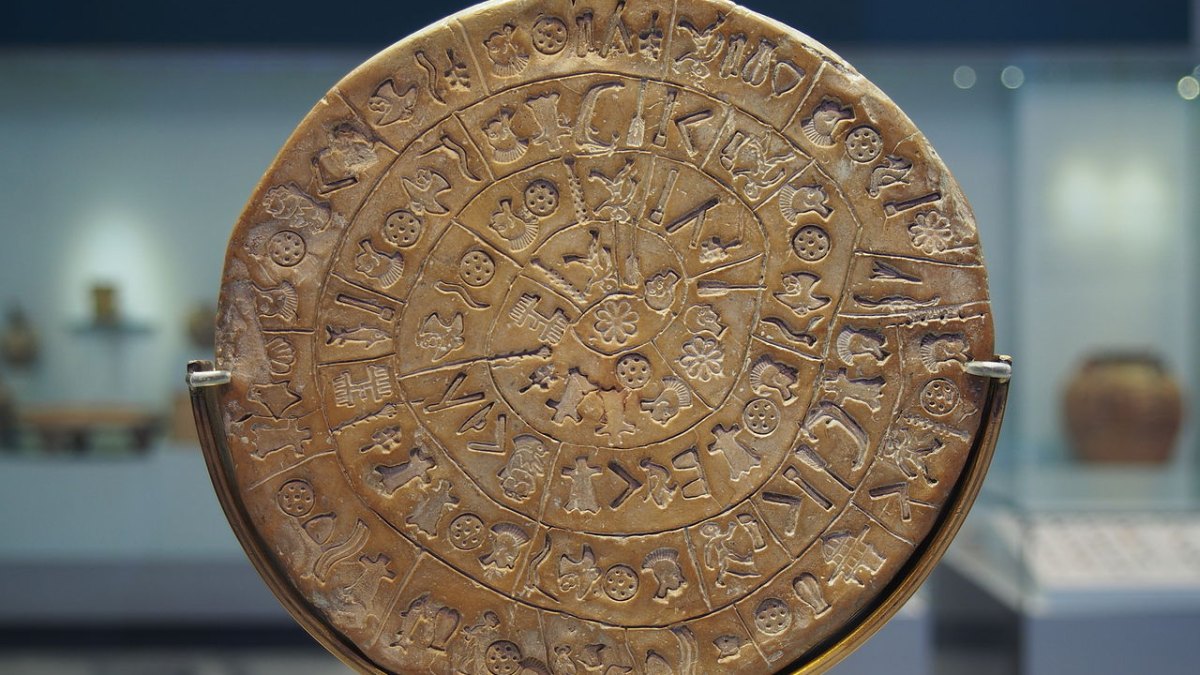
On July 3, 1908, Luigi Pernier was excavating a basement room in the Minoan palace complex at Phaistos, on the southern coast of Crete, when he uncovered something that had no obvious parallel in the ancient world. The object was a disc of fired clay, roughly 16 centimeters across and about 1 centimeter thick, about the size of a modern CD. Both of its faces were covered in symbols, pressed into the clay in a clockwise spiral running from the outer rim inward toward the center. Thin lines, cut by hand before firing, divided the spirals into 61 distinct sections containing groups of signs. The disc dates to approximately 1700 BCE, placing it squarely in the Middle Minoan period.
What makes the Phaistos Disc genuinely extraordinary is how it was made. The symbols were not scratched or incised freehand into the clay. They were stamped using individual carved dies, each pressed into the soft surface before firing. Scholars examining the disc have identified 45 unique characters repeated across 241 total impressions. That means someone in Bronze Age Crete possessed a set of at least 45 separate stamps and used them in deliberate sequence to compose a text. This is a form of movable type, predating Johannes Gutenberg's printing press by approximately 3,200 years. No other example of this technique exists anywhere in the ancient world from this period.
What the Symbols Show
- 241 total symbol impressions across both sides of the disc
- 45 unique characters, many depicting recognizable figures: a human head, a fish, an eagle, a shield, a child, a hand, a beehive, a ship's prow
- Stamped, not carved, the earliest known use of reusable type
- Spiral arrangement on both faces (Side A: 31 groups; Side B: 30 groups)
- Hand-ruled dividing lines separating sign groups, suggesting structured composition
Where It Fits, and Where It Doesn't
The disc was found in the same stratigraphic layer as Linear A tablets, the undeciphered script used by the Minoans for administrative records. But the Phaistos Disc symbols bear no clear resemblance to Linear A, nor to the older Cretan Hieroglyphic script, nor to any other known writing system of the Bronze Age Aegean. Some researchers have proposed it originated outside Crete entirely, possibly from Anatolia or the Levant, and arrived at Phaistos as an import or diplomatic object. Others maintain it is a purely local invention, perhaps used only briefly or in a specialized ritual context, which would explain why no second example has ever been found.
Decipherment Attempts
Linguist Yves Duhoux of the Université catholique de Louvain conducted a rigorous statistical analysis of the sign sequences and concluded that the disc almost certainly encodes a natural human language, the patterns of symbol frequency and grouping are consistent with grammar. What that language is, however, remains entirely unknown. Proposed readings have ranged from a hymn or prayer to a harvest calendar, a geometric land survey, and a sacred itinerary of Minoan religious sites. None has achieved consensus. The fundamental problem is that without a bilingual key, a Rosetta Stone equivalent, there is no external anchor from which to begin decoding an unknown script in an unknown language.
In 2014, Dr. Gareth Owens of the Hellenic Mediterranean University made headlines by claiming partial translation, suggesting Side A contained a prayer to a Minoan goddess. His readings were met with considerable skepticism from mainstream archaeologists.
The Object Itself
The disc is currently housed in Case 41 of the Heraklion Archaeological Museum on Crete, where it has been on continuous display since its arrival in the early twentieth century. After more than 115 years, the Phaistos Disc remains undeciphered. It is a document written by someone who clearly intended it to be read, pressed carefully into clay with purpose and craft, then fired and preserved, waiting still for the reader it was made for.
💬 Discussion (0)
Leave a Comment