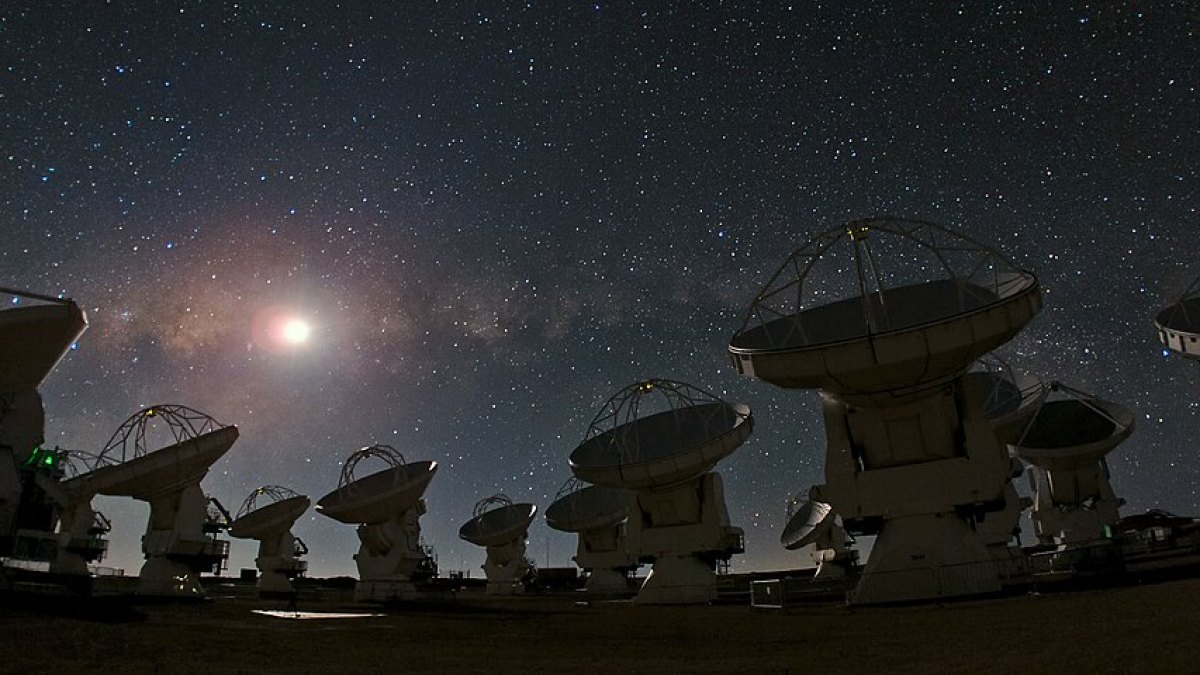
In the high-altitude plateau of the Chilean Andes, the Atacama Large Millimeter/submillimeter Array (ALMA) stands as a beacon of astronomical discovery. Consisting of 66 high-precision antennas, ALMA is the most extensive ground-based telescope system ever built. Situated 5,000 meters above sea level in the Atacama Desert, these antennas work in unison to observe celestial bodies at millimeter and submillimeter wavelengths. This capability enables ALMA to peer through cosmic dust clouds and study the universe's coldest objects. Since its completion in 2013, ALMA has revolutionized our understanding of star formation, galaxy evolution, and the chemical composition of distant worlds.
The Technology Behind ALMA
ALMA employs 54 twelve-meter and 12 seven-meter antennas, meticulously coordinated to function as a single telescope. This coordination is achieved through interferometry, a technique that combines signals from each antenna to simulate a much larger aperture. With a total array diameter of up to 16 kilometers, ALMA can achieve unprecedented resolution and sensitivity. Each antenna is equipped with state-of-the-art receivers cooled to near absolute zero, minimizing thermal noise and enhancing detection capabilities. This technological prowess allows ALMA to capture radio waves from distant galaxies and molecular clouds, offering insights into the universe's earliest stages.
Scientific Discoveries and Contributions
Since its inception, ALMA has provided astronomers with invaluable data leading to numerous discoveries. In 2019, ALMA contributed to the first-ever image of a black hole's event horizon, collaborating with the Event Horizon Telescope. The array has also uncovered evidence of complex organic molecules in protoplanetary disks, hinting at the potential for life beyond Earth. Furthermore, ALMA has observed the birth of new stars and the dynamic interactions within galaxy clusters. These findings have significantly advanced our understanding of cosmic phenomena and continue to inspire new research directions in astrophysics.
International Collaboration and Future Prospects
ALMA represents a monumental achievement in international scientific collaboration, involving partnerships between institutions across North America, Europe, and East Asia, in cooperation with the Republic of Chile. The project's success has paved the way for future enhancements, including the potential expansion of the array and upgrades to its receivers and data processing capabilities. These advancements will further refine ALMA's observational power, allowing it to explore even fainter and more distant objects. As technology evolves, ALMA remains at the forefront of astronomical research, poised to unravel the universe's deepest secrets.
- ALMA's construction was completed in 2013, after a decade of planning and development.
- The array operates at altitudes of 5,000 meters, where atmospheric conditions are optimal for observing millimeter wavelengths.
- ALMA's data is processed by a supercomputer capable of performing 17 quadrillion operations per second.
- Each antenna in the array can be repositioned, allowing for flexible configurations depending on observational needs.
- The ALMA project involves contributions from over 20 countries, reflecting its global scientific importance.
As ALMA continues to push the boundaries of what's possible in radio astronomy, it remains a crucial tool for understanding the universe's complexities. Its contributions to science have been profound, providing new windows into the cosmos and challenging our perceptions of space and time. With ongoing support and technological advancements, ALMA will undoubtedly keep revealing cosmic mysteries for decades to come, inspiring future generations of astronomers and scientists worldwide.
💬 Discussion (0)
Leave a Comment